Why Clean Bins Matter for BS6, Millipore Cleanliness and Component Quality
An industrial bin cleaner is an engineered water-based chemical for cleaning returnable plastic bins, trays and crates used to move components between processes. For BS6 and EV component manufacturing, where parts must meet defined Millipore cleanliness values, ordinary detergent or caustic washing is no longer enough. A dedicated bin cleaner used at around 5% concentration and 60-70°C removes oil, swarf and coolant residue with repeatable results.
Introduction
In automotive and precision manufacturing, component cleanliness is not only about cleaning the part. The bin, tray, crate or tote used to store and move that part also plays a major role.
A component may be washed properly and ready for dispatch, but if it is placed inside a dirty plastic bin, it can again pick up oil, grease, swarf, dust, grime, sticky residue or fine particles. This can affect final cleanliness, increase Millipore value and create rejection risk.
This is why industries need a proper plastic bin cleaner instead of ordinary detergent, caustic soda or manual washing.
Why Bin Cleaning Became Important After BS6
When the Government of India moved the automotive industry from BS4 to BS6 emission norms, it was not a small step. The industry did not move slowly from BS4 to BS5 and then to BS6. It was a sudden big jump, and it created pressure across OEMs, Tier-1 suppliers and component manufacturers.
The purpose of BS6 was to reduce vehicle emissions much more strictly. To achieve this, the whole engine system had to become cleaner, more controlled and more consistent.
For BS6 engines, three things became very important:
-
Fuel quality
-
Engine oil quality
-
Component cleanliness
Component cleanliness became critical because an engine is not made from one part. A modern engine assembly can have 10,000+ parts and components coming from multiple suppliers. All these parts finally come together and must perform as one clean, controlled system.
Even one dirty component can affect the final engine performance. If contamination enters the engine through one part, it can disturb cleanliness, increase wear risk and affect emission performance. This is why OEMs and Tier-1 suppliers started giving defined Millipore cleanliness values to component manufacturers.
Before a component reaches the engine or final assembly line, it must meet a defined Millipore cleanliness value. If the bin is dirty, it can transfer contamination back onto the clean part and increase the risk of cleanliness failure.
What Is Millipore Value?
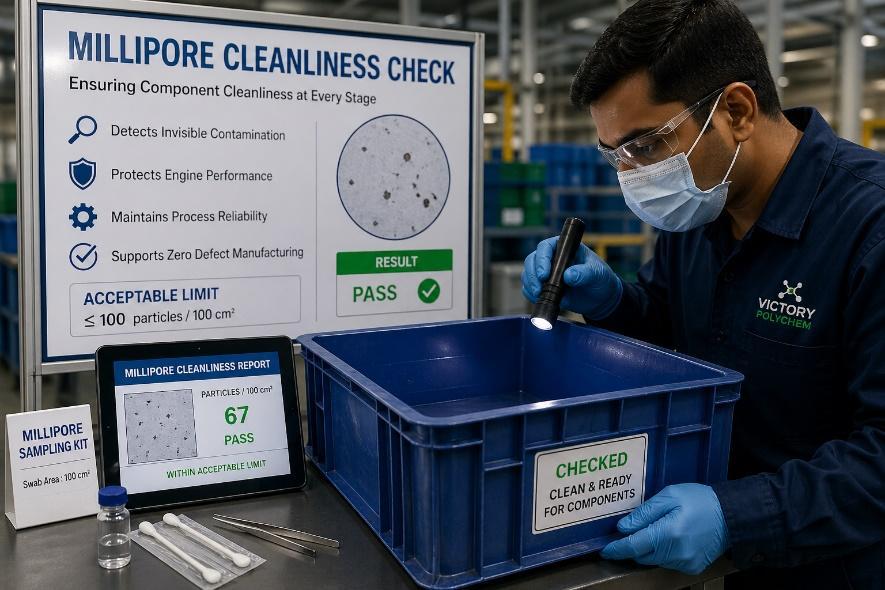
Millipore value is a cleanliness measurement used to check how much contamination is present on a component.
In simple terms, the component is washed in a controlled way. The wash liquid is then filtered through special filter paper. The collected contamination is measured to check how clean or dirty the part is.
For example, one component may have a very low contamination limit, while a bigger component may have a higher limit. If the contamination is above the allowed limit, the component can fail the cleanliness requirement.
"Quality teams keep checking the washing machine, the chemistry, the filter paper, the rinse water. The bin sitting next to the line is the last place they look. In nine out of ten Millipore failures we have investigated, the bin is part of the story." — Mr. Ameeth Kkaulgud, Technical Director, Victory Polychem
The Hidden Problem: Dirty Bins Can Make Clean Parts Fail
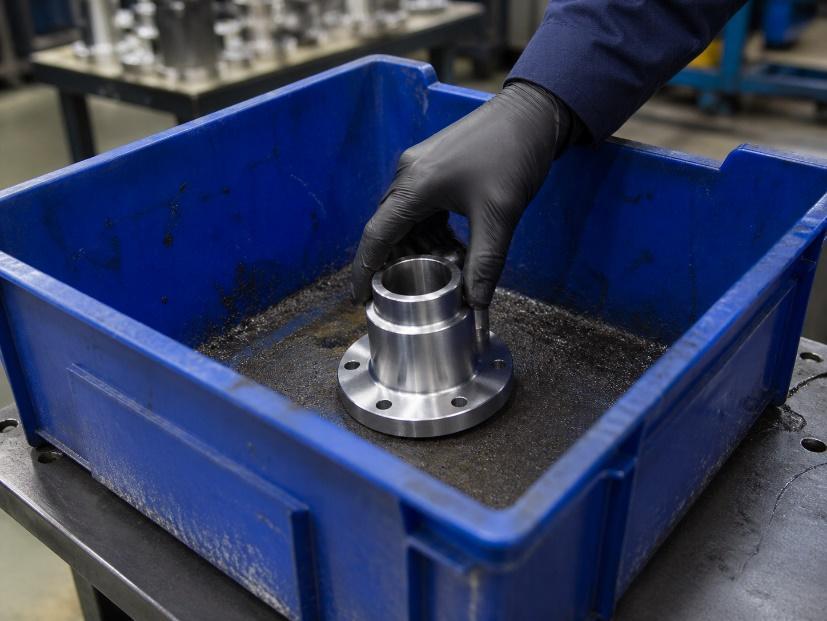
Many plants focus on component washing machines, cleaning chemicals and inspection methods. But the bin is often ignored because it looks like a simple handling item.
This is a hidden problem.
Clean components can get contaminated again after washing.
-
Millipore value can increase because of dust, oil, swarf or fine particles from the bin.
-
OEM or customer rejection risk increases even when the component washing process is proper.
-
Old oil and coolant residue can create bad smell and sticky deposits.
-
Fungus, black spots and shop-floor dirt can build up on reusable plastic bins.
-
Manual cleaning may leave hidden contamination in corners and ribs of the bin.
-
Dirty bins can disturb clean part movement between supplier and OEM locations.
-
Quality teams may keep troubleshooting the component cleaning process while the actual issue is the storage bin.
Old Cleaning Approach vs Engineered Bin Cleaning
Many companies cleaned bins manually using basic detergents, caustic soda, Household Washing Powders or just water. This cleaning approach depends heavily on manual effort and does not always give repeatable cleanliness.
Stringent Millipore Compliance needs a more robust cleaning solution. This is where purpose engineered bin cleaning becomes important.
| Parameter | Detergent / Caustic / Manual Cleaning | Engineered Bin Cleaner |
| Cleaning consistency | Depends on operator effort and time. | Repeatable & process-controlled. |
| Oil and grease removal | May remove visible dirt but leave oil films. | Engineered to remove oil, grease, grime and coolant residue. |
| Fine particle removal | Fine dust and swarf can remain in corners. | Helps dislodge fine contamination from bin surfaces. |
| Redeposition control | Removed dirt can settle back on the wet bins. | reduce-redeposition property helps keep removed contamination away from the surface. |
| Plastic surface safety | Harsh caustic cleaning can dull, stain or damage plastic over time. | Designed for industrial plastic bins when used at recommended concentration. |
| Smell and sticky residue | Bad odour and sticky deposits may remain. | Helps remove the source of odour by removing old oil, dirt and deposits. |
| Automation suitability | Not ideal for controlled spray or automated bin washing. | Suitable for spray, dip, immersion, pressure wash and automated bin washing systems. |
| Millipore support | May not support strict cleanliness control. | Supports Millipore-driven component cleanliness by reducing bin contamination. |
| Cost view | Looks cheaper initially but can create rework and rejection cost. | Higher process discipline, but useful where cleanliness failure is costly. |
Key Benefits of Bin Cleaner
-
Removes oil, grease, grime, swarf and dust from plastic bins.
-
Helps reduce contamination transfer from bin to component.
-
Supports Millipore-driven cleanliness requirements.
-
Helps control sticky residue, bad smell, fungus and black spots.
-
Suitable for spray, dip, pressure wash and automated bin washing systems.
-
Low-foam and workshop-friendly for industrial cleaning processes.
-
Supports repeatable cleaning compared to manual detergent or caustic cleaning.
-
Helps improve clean part storage, movement and dispatch quality.
Who Should Use a Plastic Bin Cleaner?
Victory Polychem’s Bin Cleaner is useful for industries where component cleanliness is critical.
It is suitable for:
Automotive component suppliers
OEM component warehouses
Engine and transmission part manufacturers
CNC and VMC machining shops
Metalworking and fabrication units
Aerospace and defence component manufacturers
Electronics and electrical component manufacturers
Precision engineering companies
General engineering plants using plastic bins, trays and crates
Plants using reusable plastic bins for clean part movement
Companies that work with strict Millipore values, component cleanliness standards and customer cleanliness audits should use an engineered industrial plastic bin cleaner instead of basic manual cleaning methods.
How to Clean Plastic Bins Quickly
A simple industrial bin cleaning process can be:
-
First, remove loose swarf, burrs, chips and dust from the bin.
-
Prepare Plastic Bin Cleaner at the recommended dilution.
-
Clean the bin using spray, dip, immersion or pressure wash method.
-
Use heated cleaning if oil, grease and grime are heavy.
-
Rinse if required by the plant process.
-
Dry the bin before reuse.
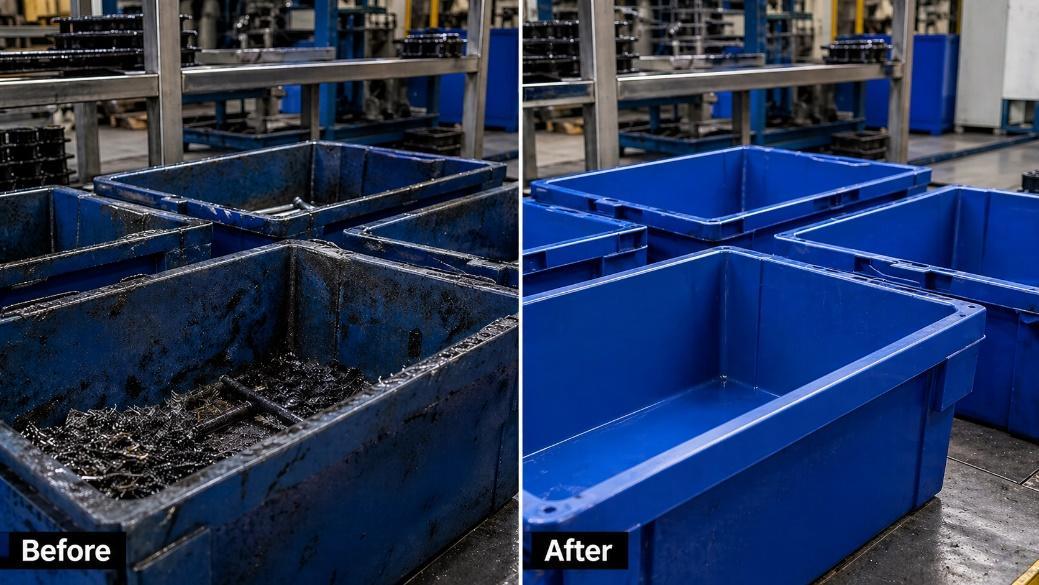
Victory Polychem’s Plastic Bin Cleaner Victory Polychem’s Plastic Bin Cleaner is a water-based bin cleaner designed for plastic bins, trays, crates and totes used in industrial plants.
It works in neutral to alkaline cleaning conditions and helps remove oil, grease, grime, swarf, coolant residue, sticky deposits, dust and fine contamination.
It can be used at around 5% concentration, depending on the contamination level and process requirement. For heavy oil and grease contamination, the bath can be heated to around 60–70°C, depending on the plant setup and bin condition.
It can be used as a:
Spray wash bin cleaner
Pressure washer bin cleaner chemical
Immersion bin cleaning chemical
Dip cleaning chemical
Automated bin washing chemical
This makes it suitable for plants that need fast, repeatable and QC Compliant Results.
Frequently Asked Questions
Is Plastic Bin Cleaner safe for polypropylene and HDPE returnable crates?
Yes. The chemistry works in the neutral to alkaline range and is formulated specifically for industrial plastic bins, trays and crates at recommended concentration. Strong caustic cleaning at the wrong concentration can dull, stain or stress-crack plastic over time. At around 5% concentration and a bath temperature of 60-70°C, the cleaner removes oil, grease and coolant residue without attacking the plastic surface. Always confirm compatibility on a sample crate before committing the full bin-wash line.
What concentration and temperature should we use for heavy oil-soaked bins?
Start at 5% concentration. For heavy oil, grease and grime contamination, heat the bath to 60-70°C. If the bins are coming directly from oily machining lines with thick coolant residue, a higher temperature within this range and slightly longer contact time will give better results than increasing concentration. Always remove loose swarf, chips and burrs before the cleaning cycle so the chemistry is not loaded with solid contamination.
Can the same chemistry be used in spray, dip and automated bin-washing systems?
Yes. Plastic Bin Cleaner is low-foam and works in spray wash, pressure wash, immersion, dip and automated bin-washing systems. The low-foam character is important for automated machines, where excess foam can disturb pump priming, level sensors and rinse stages. For manual or semi-automated lines, the same concentration window of around 5% applies.